Monday, August 22, 2022

Ruminations of Ithaca, August 2022


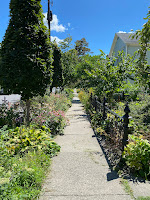
This garden smells amazing!

Sometimes you forget how Ithaca feels until you haven’t been here in a while. You forget how it feels to be here - like the fact that in the summertime  everything smells really good. People have so many flowers -  their whole front yard and the grass between the curb and the sidewalk are full flower gardens -  wildflowers, unbelievable smelling neighborhoods. 

You forget how many trees there really are here. And those trees have changed so much since the last time you were here. Every house you walk by reminds you of someone you used to know who lived in it. When I used to live here it felt like some people lived in the same rental the whole time I knew them, but in retrospect it may be because I didn’t really know them very long. Whereas other people, like me, moved all the time. Sometimes 2 or 3 times a year. 

You never knew where I was unless you knew someone who knew me. Here are just a few of the houses I lived in.


Some of these houses look like they haven’t changed since the last time I was here, and some look like they haven’t changed since I lived here 22 years ago.  

Houses that used to be glorious are run down and haven’t been painted in a while, or have random boards holding up the columns on the porches. Every place seems a little run down compared to what it looked like 22 years ago, except for the apartment building at 501 Tioga. It’s newly painted and fresh looking, and it used to be tenement housing in the 90s. Most properties are rentals, and you can tell which ones are rented and which are owner-occupied by how run-down they are.

Things have changed but things have not changed and I’m liking that. Actually, it’s nice to see things that remind me of old times and in between them things that I have no recollection of whatsoever. Like the two tiny houses on Auburn Street that were built in the side yards of other houses.   

The other thing you forget about Ithaca when you’re not here for a while is that almost everybody has a dog. They take their dogs everywhere and everybody will talk to you about their dog, whether they know you or not. Like one dog was sniffing me and I was holding my hands behind my back, and the owner said I could just pet him if I wanted. I said oh I know that’s probably true but no one can pet my dog, so I don’t test other people‘s dogs by petting them. She laughed, I said goodbye and walked away. She turned around and shouted “he approved of you, you know! The dog approved of you!” I thought that was really sweet, although how can you tell? The dog just sniffed me, that was it! 

Or another guy in the intersection had a golden retriever, and the dog’s face was just so open and friendly and happy, so I said “your dog has a great face”, and he said “oh thank you!” like it was the best complement you could pay him. But the dog DID have a great face. That’s the kind of thing you can say to complete strangers in Ithaca.  I probably wouldn’t do that walking around Syracuse. Maybe in the University neighborhood or on my own street, but that’s about it. In Ithaca everywhere is the University neighborhood, I guess that’s a difference.  

When I saw Tom Holton today at the farmers market, he recognized me right away, even with my mask on. He just saw my eyes and he knew it was me, whereas I knew it was him because he was in the same stall he and his wife have been running at the farmers market since they got married, like, 29 years ago. But I haven’t seen anyone else yet that I recognize. I see people that could be people I might know, but that pretty much counts everybody. In Ithaca looks like someone you might know, but you also know that most people rotate out of here after a few years, so it could be that nobody here is anybody I know! it’s an odd cultural thing that happens here, this rotating citizenry with the University cycles.

The other thing that always changes here is that businesses keep moving in Ithaca, so things that you assume will be here are not here. For example, there was a Gimme Coffee on State Street last time I was here, next to a lesbian bar, but no such thing exists now. Or the new business that took over the old women’s bookstore building. Or the fact that a number of the residential houses on Green Street appear to be businesses now, and vice versa. So the house I used to live in on Green Street is unrecognizable to me – could be it’s been torn down, or  maybe they painted it, or maybe it’s so rundown I don’t recognize it.

They are also really dedicated to renewable energy in Ithaca, like this one building that has 30 solar panels on it just because it can.


Wednesday, April 13, 2022

Things that make you FEEL like a failure, but don't MAKE you a failure...

We all develop at our own pace. This list echoes the concerns of so many young adults, however, who feel like they are failing relative to society's expectations or what they see their peers accomplishing. Set aside for a moment the truth that we should not compare our insides to other people's outsides because we have no way of knowing what they are really going through.

Things that don't make you a failure (Reddit user u/qevo):

  • Ending a relationship
  • Admitting you need help
  • Not owning your own house
  • Having a different timeline than others
  • Not being married by 30 or 40 or 50
  • Taking longer to reach your goals
  • Taking a break from a stressful life
  • Feeling like you're behind
  • Not having your dream job
  • Not wanting the same things as everyone else

Many of the achievements referenced in this list assume that we all develop at the same pace - owning your own house, being married by a certain age, etc. While other items that can be construed as indicators of failure - taking longer to reach your goals, having a different timeline, feeling like you're behind - are based on preconceived notions of what development is supposed to look like. But existing models of development may be based on outdated notions, or may be ignorant of the role of trauma.

I remember taking a human development course in graduate school and learning what the developmental tasks were for each decade of adulthood, according to Erik Erikson's stages of psychosocial development. 

I was 37 at the time, and I realized that up to that point, I had consistently been a decade behind where Erikson said I should be. Now, keep in mind that his stages were developed in the 1930s, and our lives were moving at a different pace 70 years later. But also, I think childhood trauma can create delays according to this model, because Erikson's theory leaves no room for recovery from childhood trauma. 

Adverse Childhood Experiences

Exposure to more ACEs leads to higher risk of behavioral and health problems later in life, like:

  • smoking
  • alcoholism
  • lack of physical activity
  • depression
  • diabetes
  • cancer
Those are just the risk factors I have seen realized in my own life. I think ACEs can also distract a person - to put it mildly - from their own psychosocial development. 

For example, I scored a 7 out of 10 on the ACEs quiz. I went on to develop an eating disorder, alcoholism, and a penchant for dysfunctional and abusive relationships, by late adolescence, during the time when I was supposed to have been navigating the "identity vs role confusion" stage. 

Which meant I spent my 20s figuring out "identity vs role confusion" when your typical 20 year old was supposedly figuring out "intimacy vs isolation." I didn't get to intimacy vs isolation until my 30s. Luckily, I didn't meet my wife until my mid-30s. By then, my psychosocial development was picking up the pace, so by my 40s I was on track. 

Realizing this explained SO much of my struggles during my 20s and 30s, you have no idea.

All of which meant that at any time in my 20s or 30s, I could check off almost every item in our original list of things that can make a person feel like a failure. Which could not be further from what I really was back then or what I really am today.

The moral of our story, then, is that we should not judge ourselves too harshly, or anyone else for that matter, because our biography exerts as much or more influence on our development as society's expectations. And the clue to determining our success lies in that biography.

Saturday, October 9, 2021

College Friends - Spoiler Alert

I'm not sure what possessed me this morning to watch "About Alex." I'm only 1 hour into it, and already I'm tired.

Somebody obviously thought "The Big Chill" needed a millennial refresh. Or maybe we make a maudlin movie about college friends for every generation in their 30s? And I just thought it was a novel idea when The Big Chill came out, because that's how self-centered you are at 18. And I'm pretty sure there was a Gen-X version, but somehow it's escaping me right now.

I remember sitting in the big lecture hall in Textor, watching The Big Chill right around this time of year, during our sophomore year at college. There were 3 of us who had gone together, all of us connected in some way to Sally. Me, P, and D.  But Sally wasn't there. She was at her Dad's wedding, I think. 

At first, in the opening credits, I didn't understand what had happened. It wasn't until they all started showing up at the church for their friend, Alex's funeral. You see, in The Big Chill, their Alex was successful in his suicide attempt. Not like the Millennial Alex, who survived his. At least, 1 hour in, he has survived it. I haven't watched the rest to find out if he tries again. Don't spoil it for me, I may still watch it.

Anyway, the rest of the movie seems pretty similar so far... old tensions resurface, people start having sex, pot is smoked, alcohol drunk, people fight, etc. One big difference is they all argue about why he tried, including getting angry at him when he intimates that he may have attempted it to get their attention. There aren't as many players in the cast, and don't get me started on the script or the acting. I can't even.

Sally pre-1983
Sally pre-1983
But back to 1984. We are watching the funeral scene, and I turn to P and D and I say "thank God Sally's just not here because she's at her Dad's wedding!" To which one of them replies, "Yeah! Right?" And then we watch the rest of the movie. At the time, I thought that somewhere in the distant future, we would all have some kind of college reunion weekend, and wondered what that would be revolving around. Something to do with Sally. I was sure of it. 

I adored Sally, worshiped her even. She was the first person to ever convince me that I was beautiful and lovable. I met her at a frat party first semester freshman year. She "caught my eye" as I was walking over to the keg, smiling that smile with her sparkling eyes, stuck her hand out, and said "Sally Auchincloss."

The next time I saw her was at a Bob Weir concert. She was a few rows behind me and my "date" -- I thought we were friends, he thought it was a date, then he got removed from the concert for smoking pot, but handed me his stash and pipe right before they nabbed him.  What can I say, life is not fair but sometimes it works in your favor. I digress. As my "date" and I were waiting for the concert to start, I looked around to see who was there, and she caught my eye again, and waved. 
 
After that, we were constantly together. She lived in the next dorm and I spent every minute I could with her. She wrote me little notes about how great I was; she turned me on to Cat Stevens and James Taylor, but mostly Cat Stevens. We commiserated about bad dates and disappointing boyfriends, we celebrated each other's new infatuations. On Valentine's Day she bought me a single red rose. When we were both dating boys and seeing less of each other that spring, we took a Wednesday off, skipped all our classes, and spent the day walking around downtown. She was a Presbyterian and took me inside the church she was going to to show me the rose window.
 
Over the summer, we wrote each other letters about how much we missed each other and how great the other was as a person, about how we couldn't wait to see each other again. I sent her an outline of my hand with the caption "everyone needs a hand to hold onto." When I was reading her letters years later, it occurred to me that these letters were love letters. 

That same summer I was also writing letters to my friend W, and I can tell you those letters, even though he and I were on-again-off-again, were so much less romantic than the letters with Sally.

(Seriously, I had no idea I was in love with her. Up to that point in my life, all relationships were painful, and I thought that to love someone was to be miserable. W was a good example of that. When we were "just friends" he was the kind of friend anyone would want - loyal, thoughtful, present; but when we "got romantic" he became emotionally unavailable. Plus, I thought I was straight, so I couldn't possible have feelings for a girl. I didn't give up that ghost until I was 22.)

Me 1987
Me 1987
My first day back on campus sophomore year, I saw her on the quad. We had this big running toward each other reunion, and a big hug. But I could feel the change in her energy. She was different. And I was scared, so I backed off, kept her at arm's length. Literally at that moment, but also the rest of that semester. We were still friends, good friends. We still hung out a LOT, but she lived across campus and ate in a different dining hall, and had new friends. And I felt awkward and uncomfortable whenever we were alone together. We never actually talked about it, but everything between us was different. Very soon afterward, she started a relationships with P and admitted to me that she was into girls. And yes, I was jealous, but I could not admit it to myself, let alone to her or P. Did I insinuate myself between them at every possible opportunity when we were hanging out together? Yes, yes I did. Did I have any insight into WHY I behaved that way? No, no I did not.

Then we went home for holiday break in December, and I never saw Sally again. She died in early January. And suddenly we were back on campus planning her memorial service. And our comments during the funeral scene in The Big Chill, and our complete lack of awareness about her health problems at that time, have haunted me ever since.


Saturday, June 12, 2021

I Am A Work In Progress

I hate my neck. Or, more correctly, I hate my mother's neck, which I have inherited. And with all the video conferences this last year, I cannot get away from it.  I doubt anyone else notices, or if they do, they don't care. Why do I even care? Why indulge this vanity? (I remember learning for the first time in my 20s that vanity cuts two ways - obsession with your own beauty, and obsession with your own flaws - and all that time I thought hating my appearance was a good thing?)

I was driving the other day, listening to P!nk's "I am here," and thinking about how much I hate my neck.

Chorus:

I am here, I am here
I've already seen the bottom, so there's nothing to fear
Know that I'll be ready when the devil is near
I am here, I am here
All of this wrong, but I'm still right here
I don't have the answers, but the question is clear

I've always thought about my history of survival and addiction when I listened to this song - surviving my childhood, surviving foster care, surviving sexual abuse, surviving my eating disorder, surviving my alcoholism. And recovering from all of these things. These are all things I've seen the bottom of, and reasons I know I'll be ready when that devil is near.

The most recent thing I've survived, of course, is my breast cancer. And this was my train of thought while listening to this song the other day. But then it hit me. I am here. Other people are not. All of it's wrong, but I'm still right here.

When I was going through chemo, I got caught up with an infomercial about how to get rid of your wrinkles, and I thought, wouldn't it be nice to live so long as to have wrinkles... I swore I would be so grateful to get through this cancer that I would be happy to get old. And I am happy to have that chance. So, why, then am I obsessed with my neck?

I am still here. Nadine is not here. Karen is not here. Steve is not here. Other Steve is not here. And so on... all lost to cancer, but not me. I won't pretend to know why me and not them; I won't even go down that road at all. There's no benefit to it.

But I was reminded on that day, and as I have listened to this song every day since, that I am so lucky to still be here, that I cannot indulge in obsessing about how much I hate my neck. I'll keep working on it.

What vanity would you abandon, for gratitude of being here?


Monday, February 24, 2020

When it comes to cancer, childhood experiences matter


I am a 12 year survivor of Stage I invasive breast cancer, and a 17 year survivor of non-invasive ductal carcinoma in situ (DCIS). When I was first diagnosed with DCIS in 2002 and, I confess, again when I was diagnosed in 2007, I allowed myself a few hours of indulgent, melodramatic, self-pity – why me? Haven’t I been through enough already? Why do I have to have cancer, too after everything else!? I think a lot of people diagnosed with cancer go through some version of "why me" as we struggle to cope with the diagnosis and all the fears that come with it.

So many people think that if a person has been through a lot of adversity in their life, they just shouldn’t have to go through cancer, too. Where is the justice in that? We all want to believe that there is a limit to how much pain and suffering one person should be forced to endure. 

Of course, we are learning more all the time about how these early exposures to adversity  actually DO increase our vulnerability to getting cancer. The evidence is growing that there are strong links between childhood adversity, in particular, and health problem like cancer in adulthood.  When I first heard about the research around Adverse Childhood Experiences, or ACEs, I decided I needed to learn more.  

ACEs have been proven to harm developing brains, can change how children respond to stress, and can even profoundly damage our immune systems for decades afterward. ACEs can lead to chronic diseases later in life, to mental illness, and to high-risk health behaviors in adulthood. It comes as no surprise, then, to see research that links childhood adversity and abuse to mental illness, drug addiction, and certain disease, including cancer. According to the research so far, two-thirds of Americans have been exposed to one or more ACEs. 

So, I had to see, what are these ACEs, and how many of them did I have when I was a kid.  I started by taking the Adverse Childhood Experiences Quiz, and learned pretty quickly that I had been exposed to 7 out of 10 Adverse Childhood Experiences. SEVEN out of TEN. 


Here are the ACEs the researchers identified:

1.     Physical abuse

2.     Sexual abuse

3.     Verbal abuse

4.     Physical neglect – not having enough food or clean clothes, etc.

5.     Emotional neglect – absence of being made to feel loved or special, or to feel close to other people in your family

6.     Witnessing a mother being abused

7.     Having a family member in prison

8.     Losing a parent to separation, divorce, or some other reason

9.     Living with someone who is depressed, diagnosed with a mental illness, or suicidal.

10.   Living with someone who is a problem drinker or alcoholic, or who used street drugs.


Learning about ACEs really changed my perspective about my cancers. If the link between ACEs and cancer is real, that means that instead  of asking “why me” when kids like me grow up and get cancer, we should be asking “why not me” when kids like me grow up and do NOT get cancer. 

In addition to my cancers, I also have a history of alcoholism and anorexia, and am now dealing with chronic health conditions some which can potentially be the result of cancer treatment or lifestyle choices that I have made. There’s always the chance, based on this research, that many of my health concerns can be linked to ACEs. Which does not mean that I, or any of us, should just throw up my hands and say, “look, I can’t do anything about this, it’s inevitable!” 

Instead, I think this means that we have to fight twice as hard, to counteract our history, if we want to overcome our childhoods and live a long and healthy life.

Which I do.

Monday, December 23, 2019

December 23, 1979

Forty years ago today, an adult in my life made a choice which changed my life forever. He sent me into a ten year long downward spiral of confusion, self-loathing, anorexia, alcohol and drug abuse. All because he believed he had a right to use my teenage body for his pleasure.


I say he made the choice on this date, but he really made the decision to follow this path months before. First though, he had to groom me, which took awhile. He had to test me by disclosing increasingly inappropriate secrets to see if he could trust me to be silent, obedient. Took me with him to places I should not have gone, and told me not to tell my foster mother. Told me personal stories, and asked me to keep them confidential. Said things and did things that I should have reported to my social worker or my foster mother, but swore me to secrecy, and waited to see if I could be trusted. Fed me alcohol at family functions, and waited to see if other adults would challenge him or if I would tell other adults where I got it.

After months of testing and grooming, I was sent to his home to babysit while he and his wife were out at 2 different activities. He came home first, asked for help wrapping gifts for her, fed me wine while I was wrapping them. After a couple glasses of wine, he acted on his decision.

It started like a seduction, if you want to call a 28 year old man molesting a 14 year old girl "seduction." Nothing violent, nothing intrusive, nothing like the events he would escalate to over the next year and sustain until I was 17 and leaving for college.  The first evening was confusing, a mix of gentle kindness, talk about my need for "instruction in sex" and inappropriate intimacy. Leaving me anxious, nauseous, confused and afraid. Swearing me to secrecy, a secrecy that knotted my stomach and left me unable to eat for 3 days.

Three days in which family and friends descended on my foster mother's home, making privacy and alone time impossible. Three days in which I became entirely invisible to any of the adults around me. Three days in which I was scolded for not eating, but in which no other adult in my life had the presence of mind to ask what happened to make me unable to eat. Or they didn't want to know. Three days in which he fed me alcohol and nobody noticed or they chose to look the other way. Three days in which he grabbed at my butt or my breasts in rooms full of other adults and nobody said anything. Three days in which he made dirty and inappropriate comments to me in earshot of other adults and everybody laughed at my embarrassment.

Three days to solidify a pattern of ownership over my physical and mental self, with noone to defend me or challenge his behavior. And three days for me to establish a pattern of coping through starvation and alcohol use.

Three days to alter the course of my life forever. It took me ten years to finally ask for help, to address my eating disorder, to get sober. Forty years later, and his choices, and the choices of the adults responsible for my safety and well-being, still haunt me.

Wednesday, July 31, 2019

What kind of person would I be if I wasn't ...

... born into poverty, would I have compassion for the poor?
... born to mentally ill parents, would I have compassion for the mentally ill?
... female, would I have compassion for women who need access to affordable reproductive healthcare? Would I be pro-choice?
... the daughter of an Irish immigrant, would I have compassion for immigrants from other countries?
... a lesbian, would I have compassion for people in the queer community? Asexual people? Trans people? Non-binary gendered people? Genderqueer people? For people in other minority groups?
... a foster child, would I have compassion for young people struggling in that system? For young people struggling as they age out of the system?
... bullied in school, would I have compassion for the underdog?
... physically and sexually abused as a child, would I have compassion for child abuse victims and survivors of childhood sexual abuse?
... raped, would I have compassion for rape victims?
... someone with an eating disorder, would I have compassion for people struggling with eating disorders or food addiction?
... an alcoholic, would I have compassion for the addicted?
... sober, would I have compassion for people struggling to stay clean and sober?
... a caregiver to parents with dementia, would I have compassion for people with dementia and their caregivers?
... a breast cancer survivor, would I have compassion for people without adequate health insurance? Without access to adequate healthcare? Living with a pre-existing condition?

We are the product of our environments and life experiences, and I know that I have relied on and benefited from the compassion of others as I faced all of the challenges stemming from these different aspects of my identity, my childhood, my adult life.

I would like to believe that had I lived a different life, I would still be compassionate and know right from wrong on all of these issues, but what if that wasn't the case? Every moral, social and political value that I hold dear is rooted in my experiences with different kinds of oppression, with the consequences of being neglected and abused as a child, with facing my own mental health issues, eating disorders, addictions, breast cancer, and the resulting chronic health concerns resulting from these experiences. All of my choices are the result of my experiences. But is that the only thing that makes us who we are?

I am surrounded by people who have not had all of these experiences, who are just as or more compassionate as I. But there are also people in this world who have many of the same experiences who do not seem as compassionate.

What IS it that makes us compassionate? What is it that makes YOU a compassionate person?